
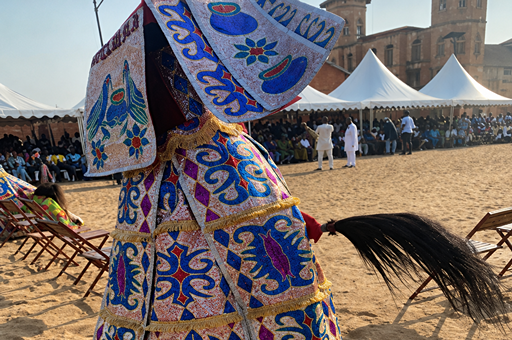
In this article, we explore What is Vodun.
Vodun is a spirituality. It is a way of living for some and a religion for others. The Vodun was born from the meeting of the traditional cults of the Yorubas gods and the deities Fon and Ewe, during the creation and then the expansion of the kingdom Fon d’Abomey (now Benin) in the 17th and 18th centuries, thanks to trade of slaves. The term that defines religion itself derives from the African voodoo term, which translates “spirit” and / or “divinity”. The Vodun is an ancestral cult based on energies and the forces of nature. It is therefore essential to know and respect the principles of the 4 elements of nature which are air, water, fire and earth.
The origins of vodun?
Originally from the ancient kingdom of Dahomey), Vodun is the cultural foundation of the peoples who come by successive migrations from Tado to Togo, the Aja peoples (including the Fons, the Gouns, the Ewe… and to some extent the Yoruba, etc.) which constitute a majority of the population in the south of the Gulf of Benin (Benin, Togo, Ghana, Nigeria).
Often demonized by Catholics, the Vodun religion suffered a lot from colonization. Ten years after independence, the vodun cult is banned by a Marxist leader who came to power by a coup. His successor ends up lifting the ban but the vodun continues to be assimilated to witchcraft by the evangelists.
At the time, slaves were not allowed to practice an African religion. Indulging in their religion or culture was strictly forbidden by the settlers, liable to death or imprisonment. As a result, it was practiced in secret because you had to be unnoticed. So there is a very mysterious veil about vodun culture and few people really know what it is about.
From the 17th century, men captured, enslaved, from this region of Africa spread the voodoo cult to the Caribbean and the Americas. Vodun is therefore found in different forms in Cuba, Haiti, Brazil or the United States, especially in Louisiana. It has also spread in North Africa, where it is found in different forms, the best known of which is Gnawa in Morocco mixed with Berber-Muslim religious folklore. Despite a presence of Muslim and Christian religions, Vodun is still present. Today there are 50 million Vodun followers around the world.
rites and beliefs
Vodun is often associated with black magic, but it goes far beyond that. It is a question of using one’s conscience and the spirits to impact the things of life.
For this, vodun followers use fetishes that are represented by many objects. It is both the divinity, its representation and its symbol. Some fetishes are more important than others. These deities often linked to an element of nature such as lightning or earth can also be attached to a very specific place such as the temple of the deity “Aïzan”, a protective fetish of the market of Houndjro in Abomey (former capital), one of the Historical city of the ancient Dahomey kingdom. Since the 19th century, the cultural and religious management of the Houndjro market in Abomey has been entrusted to the Azon family. This circular block is the oldest fetish in the country and plays a key role in the country.
Vodun dolls serve as Vodun rites as “representations” that embody a person, and not always for perverse purposes. Currently, this religion sometimes mixes the characteristic elements of the original religion with elements of a Christian nature. Among the elements saved by the original religion is the voodoo doll that is suitable to gather the essence of the person to defend or avenge. Indeed, despite beliefs, Vodun dolls are not necessarily used for witchcraft purposes. Above all, they have a role of protection and benevolence.
Vodun followers
Vodun is very present in some cities. New Orleans is impregnated with it, and it is found everywhere in Abomey, in each district, in fresco on the walls, in statuettes frozen on the ground. Messages between the Vodun and the communities are flourishing on every street corner as a village guard.
The stereotype of an evil vodun cult remains present in everyone’s consciences, even if one is of another confession. The belief in its power is stronger. We notice that literature and cinema have shaped our image of vodun but it is in reality a very living spirituality practiced by the descendants of African slaves.
Vodun can be described as a religion, a culture, a heritage, a philosophy, an art, a language, a style of music, a power, an oral tradition or even rites. What is certain is that there are different interpretations of Vodun. Some are demonized, others are considered sacred. But today, its practitioners display their belief without fear and voodoo endures from generation to generation.
More about What is Vodun
Curious to read more? Find further background on What is Vodun on Wikipedia.
Ready to experience Africa for yourself? Explore our destinations or plan your journey with Timuntu Travel.