
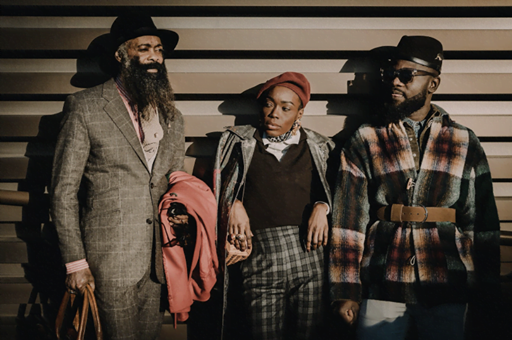
In this article, we explore Sapeurs Congolese costume.
Generally, each country has a sense of style that identifies them or rather distinguishes them from other countries.
Travelling across the African continent you will find similarities in our African diversity, but there is always a way to differentiate ourselves. Our creativity has become our identity, the way we choose to express ourselves through the arts is how we are recognised around the world.
The origin of the S.A.P.E.
S.A.P.E. From its acronym: the “Society of Ambianceurs and Elegant People”.
In the Middle Ages, during the meeting between the Portuguese and the Kongo people, the Portuguese discovered a well-organised state. The Kongo people had acquired a certain mastery of the weaving loom which was booming. Thanks to their creativity, the Kongo people even succeeded in developing a textile industry whose quality of fabrics rivaled those of Europeans.
Originally we were therefore not talking about the sape but rather the “bunkete” which means cleanliness. This movement was amplified with the “boys” who were servants at the service of a European in the colonial or ex-colonial countries of black Africa. These boys who were sometimes guardians or gardeners inherited their master’s clothes. This is how they could, at that time, dress in an ostentatious way. This gave rise to several modes such as the bombach with its oversized mode. The custom of the S.A.P.E. dates back to the 1920s. Often mistakenly mistaken for sapology, S.A.P.E. has its own definition.
S.A.P.E., a protest movement
At that time, many considered white men as superior, because of their sophistication and elegance, and many Congolese wanted to imitate them. Considered as disturbing, the first sappers used this protest movement because the Sape was the only weapon they had to claim certain rights. In 1922, Grenard André Matsoua was the first Congolese to return from Paris dressed as real French. His arrival aroused great admiration among his compatriots; He became the first great sapper and is known as the precursor of the Congolese undermining.

S.A.P.E. has always had an impact on the policy. It was for a long time banned by the former President of the Democratic Republic of Congo, Joseph-Désiré Mobutu through his campaign of authenticity. The latter had prohibited the wearing of the costume and the caravan and had imposed the wearing of the uniform also called the ”Abacos”, which is a word derived from the French pronunciation “Down with the costume”. Its objective was to rid the country of the persistent remnants of colonialism and the continued influence of Western culture and to create a more centralized and more singular national identity. Politics began to decline in the late 1970s and was mostly abandoned in 1990.
The S.A.P.E., a real Congolese culture
A certain youth often represented by artists such as singers or actors began to protest with clothing mores and to adhere to another way of dressing other than by wearing the abacos. So they wore the suit, tie to restore value to their art.
This is how some musicians such as Papa Wemba have succeeded in democratizing the S.A.P.E. In Kinshasa, Papa Wemba is known as the “King of Sape” because in Kinshasa, he was the first main actor to broadcast it on a large scale. He brought out the movement across Africa, particularly in the important in the West and in Europe. Through his orchestra, by fusions and featurings with other great artists like Peter Gabriel, La Rumba has become more democratic. And who said Rumba, said Papa Wemba and who said Papa Wemba also said the S.A.P.E.
This custom became famous in both cities (Kinshasa and Brazzaville) and continually gave the Congo the recognition it deserves after a difficult time not to be recognised by tourists, stimulating sustainable tourism in the Democratic Republic of Congo and the Republic of Congo.
S.A.P.E. Has made incredible waves in the fashion industry. It is known as the sense of male subcultural fashion emerging from the city of Kinshasa and Brazzaville. This sense of fashion represents the gentlemen who devote their money and their time to looking elegant and modern, for them it has become a lifestyle more than just a fashion dilemma. Today, the custom and culture of S.A.P.E. expanded to include women and children.
The wear and tear of Congolese fashion, among other reasons such as the rich minerals of these two neighbouring countries, was the key factor in the country’s economic development. As tourism is relatively rising in the Congo, these two countries have a common national strategy which is the hope for a future that sustainable tourism can open up paths for middle-income job creation in rural and urban areas with a national tourism plan that involves programmes for fashion and Arts. As much as this custom was once prohibited in the DRC, it has grown massively for the benefit of the country and has been exposed, until it spread across Africa and the United Kingdom, showing the incredible Congolese talent.
As a committed and responsible travel agency, Timuntu Travel salutes this fashion talent that is the S.A.P.E. And recommends that you stop in the DRC or the Republic of Congo to live an incredible encounter with the different lovers of SAPE.
More about Sapeurs Congolese costume
Curious to read more? Find further background on Sapeurs Congolese costume on Wikipedia.
Ready to experience Africa for yourself? Explore our destinations or plan your journey with Timuntu Travel.